AI Engineering: Building a Capability, Not Just Another Team
Why scaling AI requires more than tools, talent, and isolated experiments.

AI is becoming part of almost every conversation about the future of software engineering. Teams are experimenting with coding assistants, automated testing, intelligent agents, and new ways of delivering software. The opportunities are real, and the pace of change is difficult to ignore.
But as I work on defining how AI Engineering should evolve within an organization, I keep coming back to a question that deserves more attention.
The challenge isn’t getting individual teams to adopt AI. It’s building an organization that can scale its adoption without multiplying complexity.
By AI Engineering, I don’t mean simply using AI tools to write code faster. I mean building the engineering capabilities, practices, and platforms that allow organizations to develop, integrate, evaluate, and operate AI-powered systems reliably and at scale. In practice, that includes governed access to models, reusable integration patterns, continuous evaluation, observability, and the security needed for AI agents to act on business systems.
From experimentation to fragmentation
Getting started with AI has never been easier. Teams can experiment with new tools, automate activities, and demonstrate promising results in very little time.
But what works for one team doesn’t necessarily work for an entire organization.
As initiatives multiply, so do the tools, approaches, dependencies, and expectations. Different teams may solve similar problems independently, evaluate success differently, or develop capabilities that could have been shared.
None of this is wrong in itself. Experimentation is essential, and innovation often starts locally. The problem emerges when isolated successes become a fragmented operating model.
We can end up with more AI initiatives, more tools, and more complexity, without a proportional improvement in how the organization delivers value.
The centralization dilemma
One natural response is to centralize.
Create a specialized team, define common standards, establish governance, and make that team responsible for driving AI adoption.
There is value in bringing expertise together, particularly when capabilities are still developing. But centralization introduces its own risks.
If every initiative requires the involvement or approval of a central AI Engineering team, that team quickly becomes a bottleneck. Instead of accelerating the organization, we’ve created another dependency.
On the other hand, allowing every team to define its own approach without shared principles can lead to duplication, inconsistent quality, and unnecessary complexity.
I don’t believe the answer is to choose one over the other. Part of it lies in distinguishing between two very different kinds of dependency. Relying on a shared platform that teams can use on their own is not the same as relying on a team for every request, approval, or implementation.
Building a multiplier, not a delivery factory
The way I see it, AI Engineering should be designed as an organizational capability, not simply as another team responsible for delivering AI solutions.
That means establishing common engineering practices, reusable capabilities, approaches to quality and evaluation, and the foundations needed to use AI responsibly.
It also means enabling teams to apply those capabilities without becoming dependent on a central group for every decision or implementation.
Consider a simple example. Several teams want AI agents that can help with customer orders: checking an order’s status, changing a delivery, or processing a cancellation. If each team builds its own integration with the order management system, the same logic, security controls, and maintenance effort are duplicated with every new agent.
A different approach is to expose those business capabilities once, as governed tools that any authorized agent can use. Shared capabilities don’t necessarily mean centralized ownership. The platform provides common standards and mechanisms, while domain teams remain responsible for the business capabilities they expose.
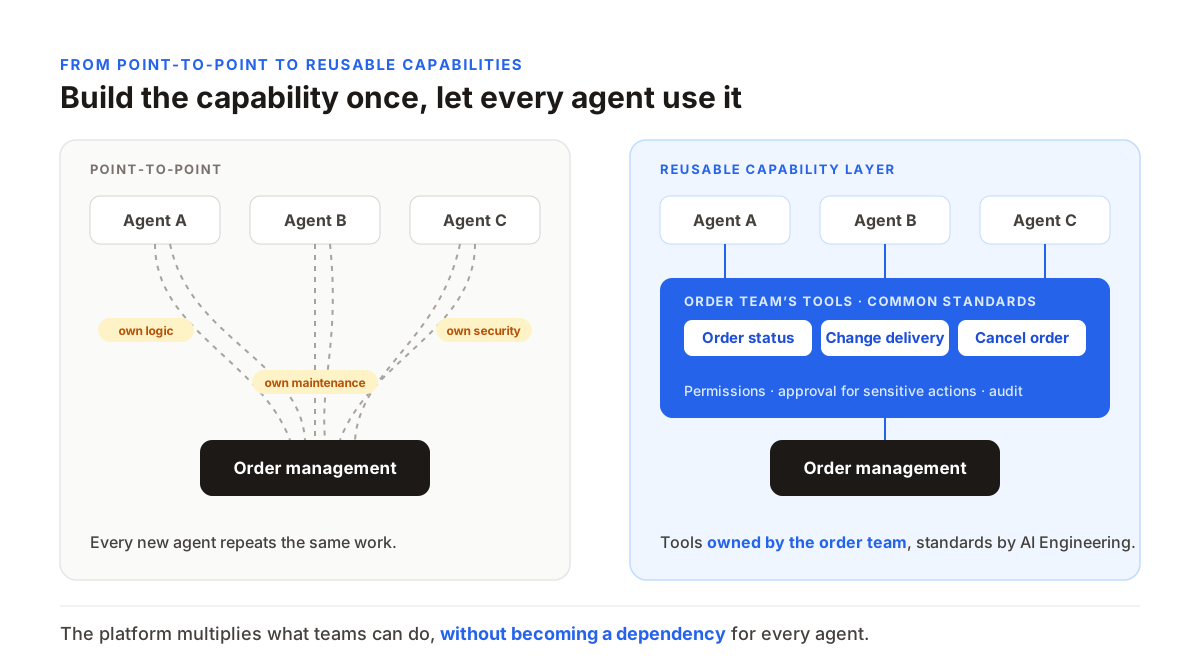 AI Engineering owns the patterns and platform capabilities. Domain teams own the business capabilities exposed to AI.
A central team may be necessary to establish the foundations, develop expertise, and accelerate the initial transformation. But its long-term success should be reflected in the autonomy and effectiveness of the teams it supports.
The success of an AI Engineering team shouldn’t be measured by how much AI it delivers, but by how much AI the organization can deliver without depending on it.
Adoption is not impact
Making AI tools available, increasing usage, or launching more initiatives doesn’t mean we’re creating more value.
Adoption is important, but it is only a starting point. In practice, no AI initiative should start without a hypothesis about the value it will create and the cost it will introduce.
We need to understand whether AI is helping teams improve quality, reduce repetitive work, accelerate meaningful delivery, or create capabilities that weren’t possible before. And, as I wrote in The Illusion of Productivity in the Age of AI, making one activity faster doesn’t automatically improve the overall outcome.
Designing for scale
No single model for organizing AI Engineering will fit every organization. The right approach will depend on an organization’s maturity, existing capabilities, architecture, and culture.
But I do believe the principles matter.
- Centralize capabilities, not delivery. Centralize what benefits from scale and reuse, without centralizing all the execution.
- Standardize proven patterns, not assumptions. Discover first, standardize what repeats, and industrialize what creates value. Turning early hypotheses into standards too soon only creates a different kind of rigidity.
- Distribute autonomy with explicit accountability. Teams should be free to build, with clear responsibility for outcomes, risks, and operation.
A capability that grows beyond the team
Scaling AI is as much an organizational challenge as it is a technological one. It requires investment in technology, certainly. But also in people, shared practices, autonomy, and the way we organize ourselves.
An AI Engineering team can build an excellent platform, with many features, and still fail to improve the organization’s ability to deliver. The real test is whether teams can build and operate AI solutions with higher quality, less effort, and fewer dependencies than they could without it.
AI Engineering should be judged by the complexity it removes, not by the infrastructure it adds.