The Illusion of Productivity in the Age of AI
Are we creating more value, or just producing more?

Every few weeks there’s a new report on how much time AI is saving. Code gets written faster, content takes seconds, and processes that used to take days are now automated. Companies are investing heavily and celebrating the gains, and the gains are real.
What these reports rarely ask is whether we’re creating more value, or just getting better at producing more.
Productivity is not value
The two are easy to confuse. An engineer can write code twice as fast and the customer won’t notice. A team can ship more features and adoption can stay exactly where it was.
Part of the problem is that we measure what’s easy to count. Hours saved, tasks completed, and lines of code generated say something about efficiency. They say very little about whether any of it mattered.
We often measure what is easy to quantify rather than what truly matters.
Moving the bottleneck
Software engineering is a good example. AI is speeding up code generation, but writing code was never the whole job. Someone still has to understand the requirements, make decisions, integrate systems, validate the result, and maintain it for years.
If those are the real constraints, more code won’t speed up delivery. It just piles up in front of the next step and creates work there. Making one part of a system faster doesn’t make the whole system faster.
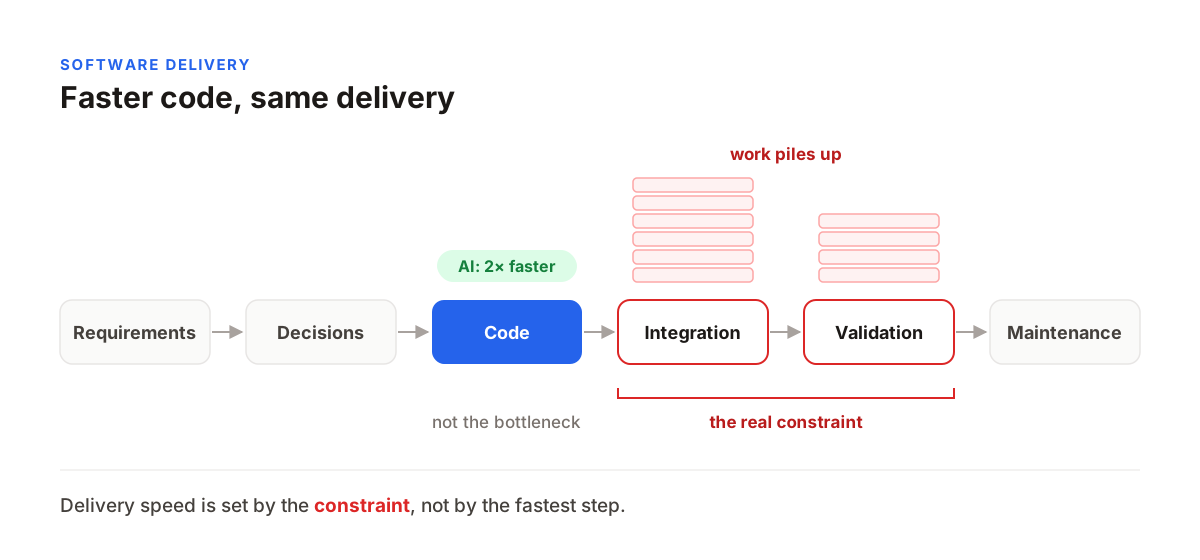 Speeding up code generation doesn’t speed up delivery when the constraint sits elsewhere. The extra output simply waits.
The cost of ownership
When something gets easier to create, we create more of it. More features, more reports, more automation. And with it, more complexity.
AI lowers the cost of creating things. It doesn’t do much for the cost of owning them. Every feature has to be maintained, every report takes someone’s attention, and every automated process adds a dependency. It’s quite possible to get very efficient at producing things that add little value.
AI is reducing the cost of creation, but it isn’t necessarily reducing the cost of ownership.
Reconsidering what deserves to be done
I think the bigger opportunity with AI is to rethink what’s worth doing in the first place, rather than doing the same things faster.
Instead of counting the hours we’ve saved, we should look at what we did with them. Did customers get a better experience? Did something important get delivered sooner? Did anything get simpler? The return on AI should be measured by the value it creates, not just by the effort it removes.
Connecting gains to outcomes
I do believe AI can change how companies work in a big way. But productivity gains alone won’t get us there. They have to be connected to outcomes that matter. And sometimes the most valuable decision is to not build the thing at all, no matter how fast we could build it.
The biggest risk with AI may not be failing to become more productive. It may be becoming much more productive without becoming any more valuable.