As Execution Becomes Easier, Thinking Becomes More Important
AI is making execution easier. What will set people and teams apart is how well they think: understanding systems, questioning assumptions, and making better decisions.

We can now produce things faster than we can work out whether we should be producing them. AI has made it much easier to write code, analyze data, generate content, and automate processes. Work that used to take days and a fair amount of specialized knowledge can now be done in minutes.
That’s a big change, and it raises a question I don’t think we discuss enough: if execution is becoming easy, what’s left to set people and teams apart? I don’t think the answer is who masters the latest tools first. I think it’s who can still think clearly about what they’re doing and why.
When output stops being the differentiator
For years, the technology industry has rewarded execution. Careers and teams were built around specialized knowledge and the ability to deliver. That still matters, and it isn’t going away.
What’s changing is where the value sits. When producing something takes less effort, the thing produced stops being impressive on its own. The value moves to the work around it: understanding the problem, questioning the assumptions behind it, comparing alternatives, thinking through what happens next.
Being able to build something used to be a reasonable signal that it was worth building, because building was expensive. That signal is fading. And delivering quickly says nothing about whether we’re heading in the right direction.
Being able to build something is no longer sufficient evidence that it should be built.
Seeing the bigger picture
AI makes it easier to work across functional boundaries, and that makes the ability to see the whole system more valuable. Deep expertise still matters, but it goes much further when you can connect it to what’s happening around it.
We’ve become very good at optimizing parts: a service, a process, a team metric, a delivery pipeline. Improving the parts doesn’t automatically improve the whole. A development team can increase its velocity and leave operations dealing with more complexity. A business unit can become more efficient by creating dependencies that slow everyone else down. An AI-assisted process can cut the time a task takes and quietly add validation and rework somewhere downstream.
I saw this recently with one of my teams. They had been using AI heavily to modernize a set of legacy systems: analysing old data structures, making sense of distributed processes nobody had fully documented, rewriting batch applications, generating tests. It was a real success, and the project is much further along than it would have been without it. But one of the services they rewrote became so much more efficient that it started putting a load on another system that had never been designed for it. The service got better. The system around it didn’t. The improvement was real. It just didn’t stop at the boundary of the team that made it. Another team ended up fixing the performance problem, also with the help of AI.
The local metric goes up. The outcome doesn’t. When we only look at our own piece, we miss the relationships, constraints, and feedback loops that actually decide the result.
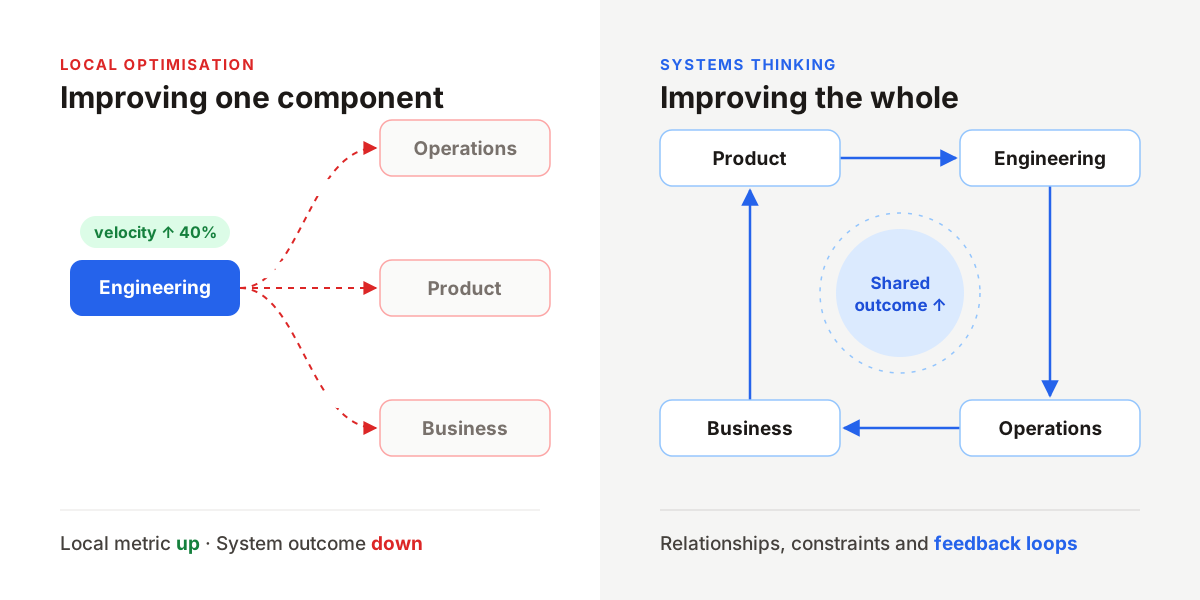 Local improvements can quietly shift cost elsewhere. The outcome is determined by the system, not by any single component.
A fix that ignores these relationships can end up costing more than the original problem. That’s why I think looking beyond your own area has become part of everyone’s job, whether you’re an architect, an engineer, a product manager, or someone designing a process.
Questioning what we believe to be true
Systems thinking helps us see how things connect. Critical thinking makes us check whether what we believe about those connections is actually true. It means separating evidence from assumption and not settling for the first explanation that sounds right.
Tech is especially prone to skipping this step. New solutions tend to arrive framed as inevitable progress. We adopt methodologies because they’re called best practices, pick technologies because everyone is talking about them, and automate things because automation is assumed to be good. We spend far more time discussing how to implement something than checking whether we understood the problem in the first place.
AI raises the stakes. It produces answers that sound convincing and solutions that look technically sound, and it produces them fast. But speed and confidence aren’t the same as being right. The more capable these systems get, the more we need to be able to judge their output on our own.
There’s a real risk here. The more thinking we hand over, the weaker the skills we need to check whether the result makes sense. If we stop questioning an answer because it’s well structured, or accept a recommendation because a sophisticated model produced it, we may end up more productive and less thoughtful at the same time.
The paradox of intelligent tools
The smarter our tools get, the more deliberately we need to work on our own judgment. AI is genuinely useful for exploring alternatives, challenging ideas, spotting patterns, and learning faster. It shouldn’t replace understanding. I want it to help people think better, not to take them out of the thinking.
I don’t think the most valuable people will be the ones producing the most with AI. They’ll be the ones using it to ask better questions and dig deeper into a problem before deciding what to do about it.
Speed and confidence should never be confused with correctness.
Learning what lasts
For a long time, learning in tech meant picking up new technical skills: frameworks, certifications, specialized tools. That still matters, but it’s no longer enough.
We should be just as deliberate about learning to reason through ambiguity, understand how the business works, weigh trade-offs, and explain complex ideas clearly. These are harder to measure and harder to teach, but they carry over from one technology, industry, or company to the next. Frameworks go out of date. Languages fall out of fashion. Tools get replaced. Being able to understand a hard problem and make a good decision about it doesn’t expire.
Redefining value in knowledge work
I think we’re changing how we define value in knowledge work. For decades, access to information and the ability to execute complex tasks were real advantages. AI is lowering those barriers, but it isn’t removing complexity. If anything, it adds to it: more decisions, more information to process, and changes that spread through organizations faster than before.
So the challenge isn’t doing more, faster. It’s making sure what we do actually matters.
We’ll have more powerful AI, more automation, and new ways of building products. But I don’t think the biggest change will be technological. It will be in how we think and how we organize. We’ll need people who question assumptions instead of following patterns, who look at relationships instead of isolated parts, and who care more about outcomes than about looking busy.
As execution becomes easier, thinking becomes more important.