The Cost of Indecision
Why avoiding decisions can be more expensive than making imperfect ones.

We spend a lot of time discussing how to make better decisions. We analyze risks, evaluate alternatives, seek alignment, and gather information to reduce uncertainty. All of this matters, particularly in complex organizations where decisions can have long-lasting consequences. But there’s something we tend to overlook: the cost of not making a decision.
When waiting becomes the problem
I’ve seen teams spend weeks waiting for decisions that could have been made in days. I remember a module in a legacy system that we wanted to switch off. It wasn’t critical, but before turning it off the team needed validation from several departments. And, as with many legacy systems, just confirming whether it was still being used could take weeks. Nobody was against the decision. Everyone simply wanted more certainty before agreeing to it. In the end, we decided to move forward without waiting for every answer. We had a good degree of confidence, based on what had already been shared and on metrics we added around the module to confirm it.
What looks like a responsible approach can become a source of inefficiency. Projects lose momentum, teams become frustrated, and opportunities disappear while organizations continue discussing what to do next.
In trying to avoid the consequences of making the wrong decision, we often ignore the consequences of making no decision at all.
The invisible cost
A wrong decision usually has an identifiable consequence, something we can measure, discuss, and attribute to someone. An unmade decision is different. Its impact is distributed across delayed projects and additional meetings.
The impact also grows with the number of people depending on a decision. What looks like a small delay for one person can translate into weeks of lost momentum across multiple teams. And because that cost is hidden across different activities, it becomes even harder to recognize. Eventually, these invisible costs can become a real obstacle to organizational effectiveness.
Not every decision deserves the same scrutiny
Some decisions require careful consideration, especially when they involve large investments, security, or consequences that are difficult to reverse.
But not every decision deserves the same level of scrutiny. Jeff Bezos captured this distinction in his 2015 letter to Amazon shareholders, describing decisions as one-way and two-way doors. One-way doors are difficult to reverse and deserve careful deliberation. Two-way doors allow us to change course if we get something wrong.
The challenge is that the distinction isn’t always obvious. A decision may be technically reversible but still carry a real cost of correction. What matters is understanding the potential impact, the cost of reversing course, and the consequences of waiting.
For decisions that are easy to reverse, waiting for perfect information can be more expensive than moving forward with reasonable confidence and adapting as we learn.
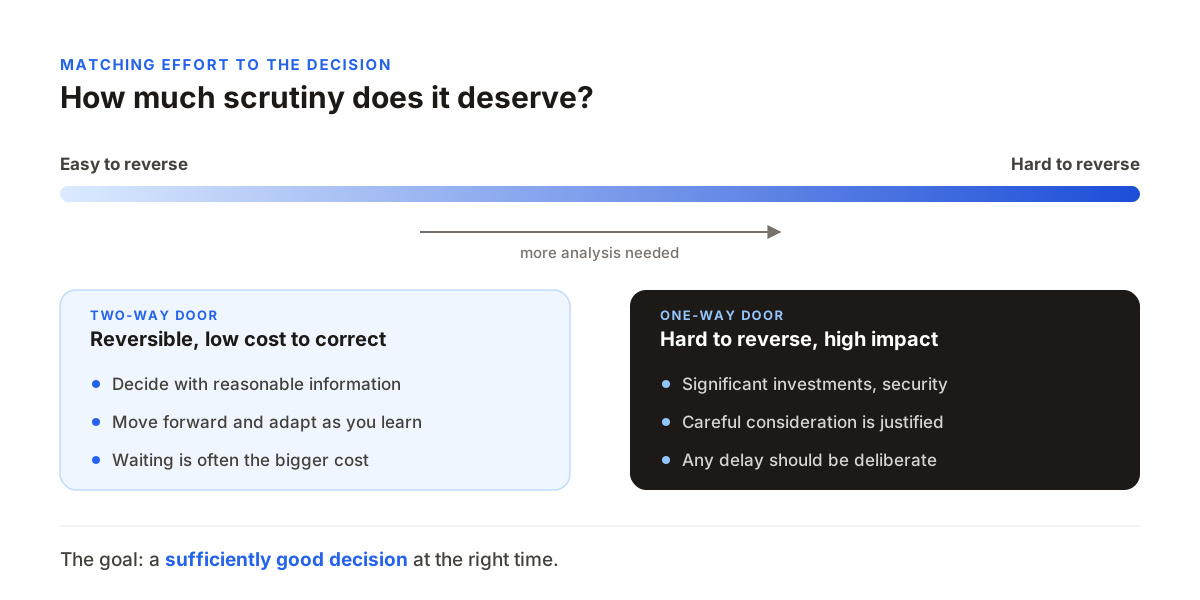 The effort a decision deserves should reflect its impact and the cost of reversing it, not simply how uncomfortable it feels.
The leadership dimension
In some organizations, decisions are delayed because responsibilities are unclear. In others, people hesitate because making a decision means becoming accountable for its consequences.
When mistakes are punished more visibly than delays, avoiding decisions becomes a rational behavior.
Over time, this creates cultures where seeking consensus becomes more important than making progress, and where alignment is confused with the need for everyone to agree.
A leader can be an excellent decision-maker and still become the biggest bottleneck in the organization if every important decision needs their approval.
The real objective is to build organizations where decisions can be made at the right level, by people with the right context, autonomy, and accountability. Otherwise, we’re replacing slow decision-making with faster centralized decision-making, without addressing the underlying problem.
This also requires accepting that some decisions will be wrong. What matters is creating the conditions for teams to make informed choices, recognize mistakes, learn quickly, and adjust course. Organizations that demand certainty before acting may reduce some immediate risks, but they also limit their ability to adapt and respond to change.
A few practices that help
Through experience, I’ve found that a few simple practices can help organizations make decisions more effectively.
- Make decision ownership explicit. Many people can contribute, but it should always be clear who has the authority and responsibility to make the final call. When everyone owns a decision, nobody does.
- Agree on when to decide. Avoid open-ended discussions by establishing a reasonable timeframe. Instead of endlessly asking for more information, clarify what needs to be learned before making the decision.
- Understand the cost of reversing course. Before debating every alternative, consider the decision’s impact and how difficult it would be to correct.
- Align without requiring unanimity. People can disagree with a decision and still commit to making it work. Alignment means moving in the same direction, not sharing the same opinion.
Acting or waiting, deliberately
The question isn’t whether we can completely remove uncertainty from a decision, but whether we understand the trade-offs between acting and waiting.
Sometimes waiting is the right decision. But it should be a conscious choice, with a clear reason and an understanding of what that delay will cost.
Not making a decision is still a decision. It just means accepting the consequences without explicitly choosing them.